

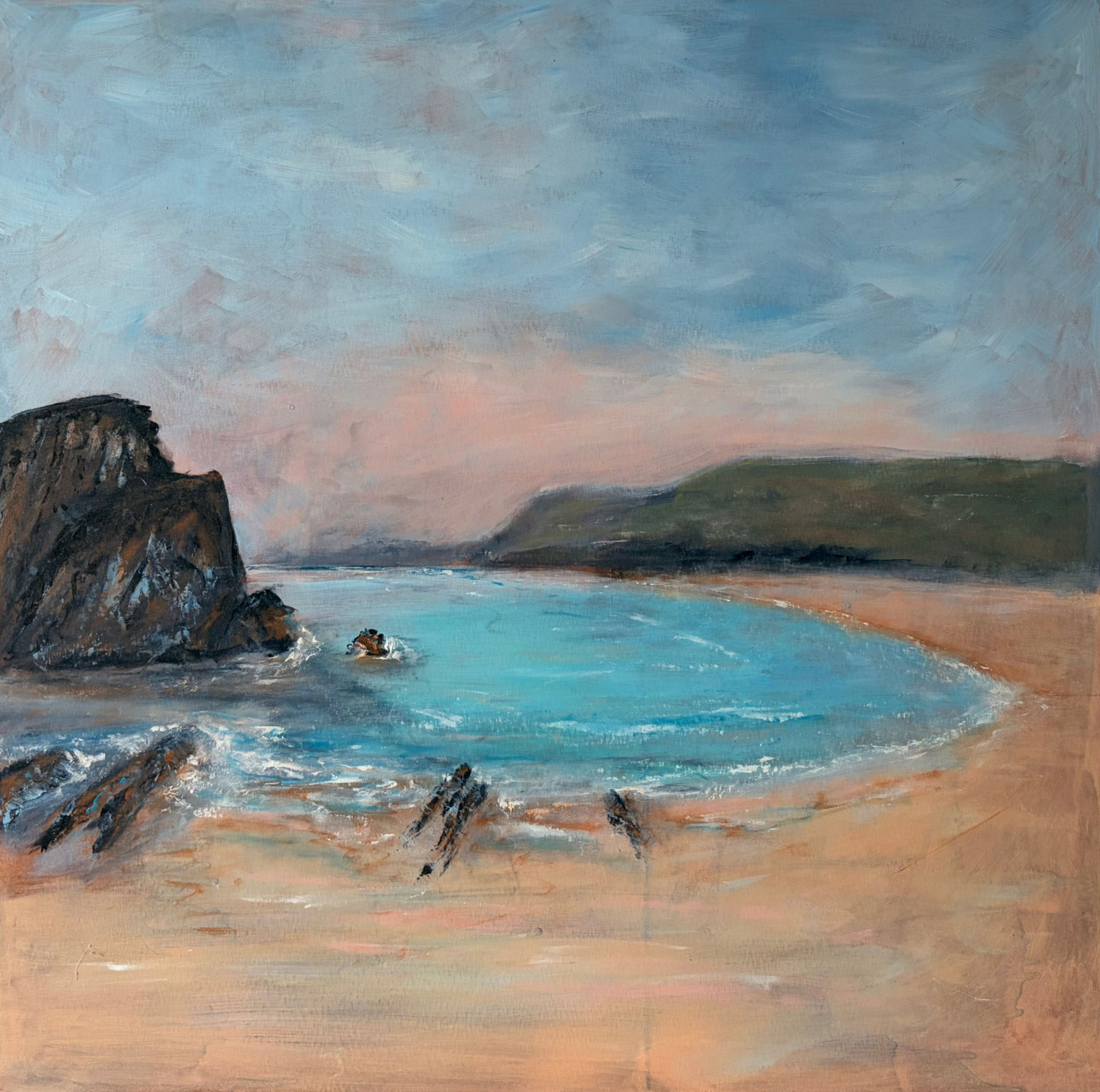
Blackpool Sands
Acrylic on Panel- Inspired by a cherished morning spent with my children at Blackpool Sands, who spent an hour rolling toy cars down the rocks during a dog walk- the artwork reflects playful colours and a serene pink sky. Handcrafted artwork that tells a story rooted in local beauty and family moments.
For the blue hues in this painting Niall used Cobalt blue. The chemistry behind it’s colour lies in the fundamental of Cobalt’s electronic configuration. In GCSE students learn that transition metals, found in the middle of the periodic table, often have coloured compounds. In A-level we introduce students to orbital electronic configuration of the elements of the periodic table, and that if a metal has an incomplete set of ‘d' orbitals, they can exhibit colour. The maximum number of electrons found within d block is 10, and Cobalt in the form of the ion within Cobalt blue (2+) has 7 d electrons. Due to the these partially filled d orbitals, electrons in these orbitals can be excited to higher energy levels, by absorbing a photon of light. These photons of light correspond to specific wavelengths of visible light. The remaining light that is not absorbed is reflected is perceived by the viewer. In the case of Cobalt 2+, the structure absorbs wavelengths in the yellow-orange-red region (around 600nm). Our eyes therefore see the complementary colours, in this case a cool, but vibrant blue.